

The 3 A.M. Glucose Dip:
waking up wired on the stack.
How a GLP-1-based plan with a pre-bed fast may affect overnight blood sugar — the counter-regulatory response that can wake you, what it means for your sleep and the stack, what to do in the moment, and how to prevent it.
Lifestyle comes first. Peptides aren't a silver bullet; sleep, nutrition, training and stress drive results.
About this briefing
Educational content only — not medical advice, a diagnosis, or a dosing guide. It explores one possible cause of overnight waking; symptoms alone can't confirm or rule out low blood sugar. Treat any reading below 70 mg/dL, call 911 for a severe episode, and follow your licensed clinician's plan if you have diabetes or take insulin or a sulfonylurea. Some GLP-1-based medications discussed here are investigational and not FDA-approved. Tesamorelin (Egrifta) is FDA-approved only to reduce excess abdominal fat in HIV-infected adult patients with lipodystrophy, and it is not indicated for weight loss management. Any other use is off-label and directed by your licensed clinician. Selection, dosing and timing are directed by a licensed clinician. Don't self-source.
The 3 a.m. wake-up: sometimes a glucose dip.
One possible reason for waking wired on the stack, and what to talk through with your licensed clinician.
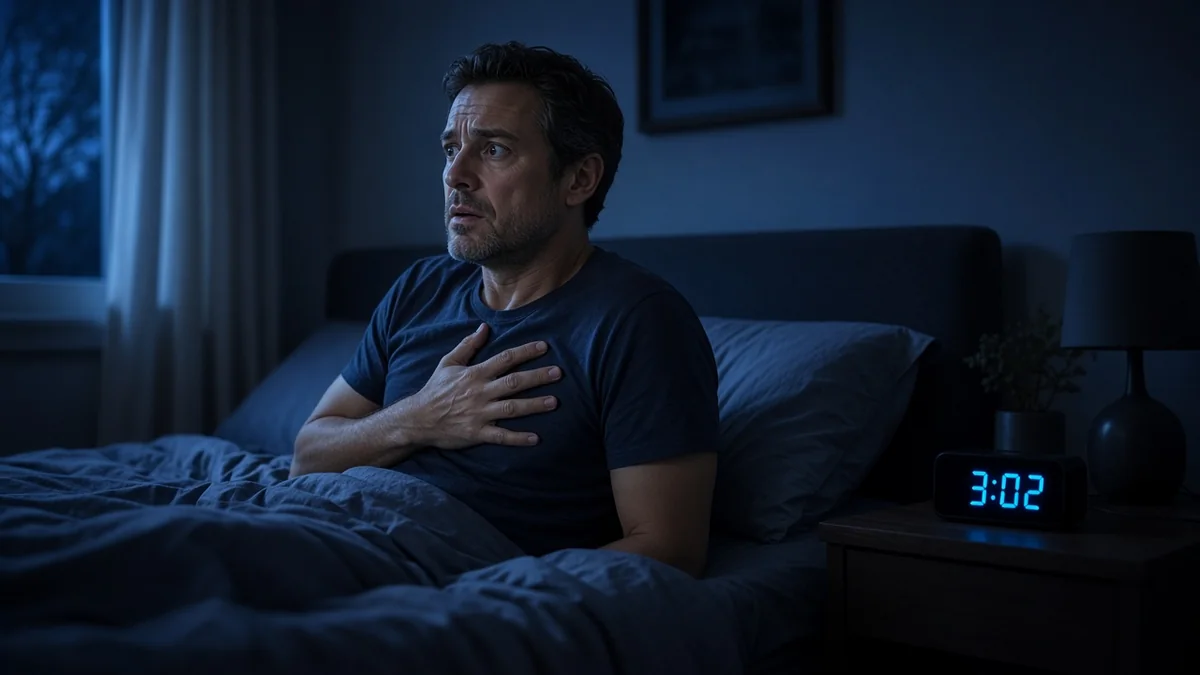
You go to bed fine and snap awake around 3 a.m. — heart racing, warm, wired. On a GLP-1-based plan with a 4-hour pre-bed fast (last meal 7pm, bed 11pm), one possible explanation is an overnight glucose dip: blood sugar drifts lower than usual and the body releases adrenaline and other hormones to bring it back up. But a wake-up like this has many possible causes, including stress hormones, sleep apnea, alcohol, acid reflux, anxiety, hot flashes, other medicines and more, and you can't tell which one it is from how it feels. A low can also happen without waking you. That's why the right next step is to measure and talk with your licensed clinician rather than guess. This briefing explains the glucose piece so you can have that conversation.
One proposed pathway: lower reserves → a deeper 3 a.m. trough → an adrenaline wake-up
Conceptual schematic for education, not measured data. See Sources in Chapter 7.
The setup
The stack leaves you lean, insulin-sensitive and carb-light — a smaller overnight fuel buffer.
The alarm
If glucose falls, the body releases adrenaline and other hormones to bring it back up. That's one possible reason for a wired wake-up, among several.
The next step
Measure instead of guessing, and bring the pattern to your licensed clinician. Meal timing and evening nutrition are often part of that conversation.
The bottom line
On this stack, a 3 a.m. wake-up may be linked to an overnight glucose dip, but symptoms alone can't confirm that or rule out true low blood sugar. Low blood sugar can happen with or without diabetes medicines, so if you ever check and see a reading below 70 mg/dL, treat it (Chapter 6) and tell your licensed clinician. When a dip is the cause, food timing is often part of the answer. Educational only, not medical advice. A licensed clinician directs every treatment decision.
How the liver holds the line — until the small hours.
Glycogen, then gluconeogenesis, and the natural 2–4 a.m. thin point.
First, how your blood sugar is supposed to behave overnight. Once you stop eating, the liver keeps glucose steady — first by breaking down stored glycogen, then by making new glucose (gluconeogenesis). With a 7pm meal and 11pm bedtime you're already ~4 hours fasted at lights-out, and by 2–4 a.m. you're 7–9 hours post-meal, relying on a mix of stored liver glycogen and newly made glucose. There's a natural shallow dip in those hours — the question is whether it becomes a steep one.
Glycogen first, then gluconeogenesis — a buffer that thins out by the small hours
Standard overnight glucose homeostasis; see Sources in Chapter 7.
Takeaway
The 2–4 a.m. window is naturally the thinnest point of the overnight glucose curve — glycogen stores are lower and the pre-dawn hormone rise hasn't arrived yet. How low varies a lot from person to person. Anything that shrinks the fuel buffer turns that normal dip into one that trips the alarm. That's the next exhibit.
Lower reserves, a thinner buffer.
Four forces from a GLP-1-based plan and the fast.
Medicines in the GLP-1 family stimulate insulin mainly when glucose is elevated (the effect is glucose-dependent), which is one reason significant lows are uncommon when they're used without insulin or a sulfonylurea. Uncommon isn't impossible. How GLP-1-based medications combine with other clinician-directed therapies overnight hasn't been studied directly. Below are four factors that have been proposed to lower the overnight floor in a lean, fasted, calorie-reduced person. They're hypotheses to discuss with your licensed clinician, not established effects.
Proposed factors: less fuel in, more efficient clearance, a thinner buffer
Conceptual schematic, not measured data. Some GLP-1-based medications discussed here are investigational and not FDA-approved. Tesamorelin (Egrifta) is FDA-approved only to reduce excess abdominal fat in HIV-infected adult patients with lipodystrophy, and it is not indicated for weight loss management. Any other use is off-label and directed by your licensed clinician. See Sources in Chapter 7.
Smaller fuel reserve
Strong appetite suppression can mean eating much less, especially in the evening, so you may reach bedtime with less stored fuel. Weight loss usually improves insulin sensitivity, which is good for health and may also let glucose run a little lower overnight. Some newer GLP-1-based medications also act on glucagon receptors, which affect how the liver releases glucose, so their net overnight effect isn't known. It's an investigational drug that is not FDA-approved.
More fat mobilization, mixed glucose effects
Tesamorelin raises the body's own growth hormone (GH), which increases the release of stored fat for fuel. GH also acts as a counter-regulatory hormone: it can transiently raise glucose and reduce insulin sensitivity, which usually pushes glucose up, not down. In the main Tesamorelin trials, glucose measures didn't change in a clinically meaningful way. Whether it plays any part in an overnight dip is unknown, and timing is a question for your licensed clinician.
Takeaway
The idea is simple: eating much less can leave a thinner overnight cushion. Whether that's what's happening to you can only be answered by measuring and talking with your licensed clinician, especially since a wired wake-up has many other possible causes. Never change a medicine on your own.
The body's support action.
Insulin off → glucagon → adrenaline → cortisol & GH.
When glucose falls toward the floor, the body doesn't wait — it launches a layered counter-regulatory defense to pull it back up. This is the “support action”: a staged release of hormones, each a stronger lever than the last. Adrenaline is the one most likely to be felt. Sleep blunts this response, though, and studies show people often don't wake during a low, so waking (or not waking) isn't a reliable sign either way.
Insulin off → glucagon → adrenaline → cortisol & GH — escalating defenses
Standard counter-regulatory hormone hierarchy; see Sources in Chapter 7.
Glucagon does the quiet work
Before you feel anything, insulin switches off and glucagon tells the liver to dump glucose. If that restores the level, you never wake. The alarm only escalates when glucagon isn't enough.
Adrenaline is the alarm
When more force is needed, adrenaline (epinephrine) floods in — raising glucose fast and producing the racing heart, warmth, sweat and sudden alertness that pull you out of sleep.
Takeaway
Counter-regulation is a built-in safety ladder, and adrenaline is its most noticeable rung. But this alarm is weaker during sleep and isn't a dependable signal: you can have a low without waking, and you can wake wired for reasons unrelated to glucose. Measuring tells you more than symptoms do.
“Wired, not tired”: a clue, not a diagnosis.
How an adrenaline wake-up can feel, and why feelings alone can't tell you the cause.
The brain relies heavily on glucose, so the body defends it, and adrenaline is part of that defense. An adrenaline surge can feel like a pounding heart, warmth or sweat, hunger and sudden alertness. The same feelings can also come from stress hormones, sleep apnea, alcohol wearing off, acid reflux, anxiety or panic, hot flashes, other medicines or a heart rhythm problem. That's why a licensed clinician, and ideally a measurement, is the way to find the real cause.
“Wired, not tired”: one pattern people describe
Illustrative only. Symptoms can't confirm or rule out low blood sugar; see Sources in Chapter 7.
Takeaway
Waking wired, with a pounding heart, warmth and hunger, is worth noting, but it's a clue, not a diagnosis. If you can, check your glucose when it happens (Chapter 6) and share the pattern with your licensed clinician. If the wake-ups come with snoring or gasping, chest pain, fainting, or confusion, get medical care promptly.
A recurring wake-up can ripple into sleep and your goals.
Broken sleep, confusing morning readings, and what's still unknown.
An occasional restless night is common. A repeating pattern is worth raising with your licensed clinician, whatever the cause, because ongoing broken sleep can affect energy, appetite, recovery and how you feel about your plan. Here are a few possible downstream effects. Some are well established and others are still debated.
Where a recurring 3 a.m. wake-up may lead
Conceptual; see Sources in Chapter 7. Connects to When Cortisol Cancels the Stack and Sleep Through the Night.
Hard to get back down
Once adrenaline is up, it can be hard to fall back asleep, so a single wake-up can cost a good part of the night.
Less deep sleep
Much of the body's natural growth hormone is released during deep (slow-wave) sleep, so frequently broken sleep is worth fixing for its own sake. Whether overnight dips affect any medicine's results hasn't been studied, so don't adjust anything on your own. Bring it to your licensed clinician.
Looks like cortisol mistiming
A glucose dip and a mistimed cortisol rise feel similar at 3 a.m. — which is why measuring (next) matters before you change anything.
Also worth knowing
An overnight low followed by a high morning reading, called the “Somogyi effect,” is a historically proposed rebound that is debated. Modern continuous glucose monitoring studies suggest it's rare, and a low overnight is more often followed by a lower morning reading. Morning readings are also shaped by the normal pre-dawn hormone rise (the “dawn phenomenon”). Either way, they're for your licensed clinician to interpret. Separately, significant weight loss can include some loss of lean mass along with fat, which is one reason adequate protein and resistance training matter. Ask your licensed clinician what's right for you.
Check first, treat a real low, then settle.
If you might be low: check, treat with fast carbs, recheck. Then darkness and slow breathing.
If you wake shaky, sweaty, pounding or hungry and think your blood sugar could be low, don't wait it out. Treating a true low quickly is always the right call. Here's the general approach used in diabetes care (American Diabetes Association Standards of Care). If you have diabetes, or take insulin or a sulfonylurea, follow the plan your licensed clinician gave you.
Check → treat if low → recheck → then dark and calm
Low-glucose steps follow the ADA Standards of Care in Diabetes—2026, Section 6. The dark-room and breathing steps are for after you've ruled out or treated a low; they don't treat low blood sugar. See Sources in Chapter 7.
Check, and treat a true low with fast carbs
If you have a glucose meter or CGM, check. Below 70 mg/dL is low; below 54 mg/dL is a clinically significant low that needs action right away. If you're low, or you have symptoms and can't check, take about 15 grams of fast-acting carbohydrate, such as glucose tablets or gel (check the label), half a cup of juice or regular (not diet) soda, or a tablespoon of sugar or honey. Don't use fatty or protein-heavy foods like nut butter or yogurt as the first fix, because they raise glucose too slowly. Recheck after 15 minutes and repeat if you're still below 70. Once you're back in range, have a small snack, for example some yogurt, a little cheese with crackers, or a few nuts, to help keep it steady.
Know when it's an emergency
Call 911 or seek urgent care for confusion, a seizure, fainting or being hard to wake, being unable to swallow safely, or a low that won't come up after repeated treatment. Never put food or drink in the mouth of someone who can't swallow or is unresponsive. If your licensed clinician has prescribed glucagon, make sure the people you live with know where it is and how to use it. Any low below 70 mg/dL, or any severe episode, should be reported to your licensed clinician.
Once you're safe, keep it dark
If your reading is normal, or you've treated and rechecked, keep the lights low and skip the bright phone (except to check a CGM or call for help). Light and screens amplify the cortisol/adrenaline and shift your clock. Minimal light keeps the nervous system heading back toward sleep.
Down-regulate the adrenaline
Slow breathing with a long exhale (4-in / 7-hold / 8-out, or a couple of physiological sighs) signals the “emergency” is over and lets the surge fade.
Cool, dark, calm
A little water or electrolytes if you woke up sweaty — but not so much you're up again for the bathroom. Then let yourself drift.
Takeaway
Safety first: if you might be low, check, treat with fast carbs, and recheck. Never skip treating a low to protect your sleep. Once you're in a safe range, darkness and slow breathing help the adrenaline settle so you can drift back. If this keeps happening, tell your licensed clinician.
Buffer the night, measure, and tune.
The bedtime snack, the CGM, and the dose conversation. With sources.
Better than managing the wake-up is not having it. The whole chain starts with a thin overnight fuel buffer — so the fixes refill the buffer and smooth the timing. These are the levers to bring to your licensed clinician.
Buffer the night, fuel the day, measure, and review with your clinician
Educational principles, not a prescription. Dose and timing changes are led by a licensed clinician. See Sources below.
Reconsider the long pre-bed fast — add a bedtime snack
If appetite suppression means you're eating very little in the evening, a long pre-bed fast may leave a thin overnight cushion for some people. A small bedtime snack with protein, some fat and a little fiber or complex carb (for example, Greek yogurt with berries and nuts, or cottage cheese) is a simple, low-risk option to discuss with your licensed clinician. In people with type 1 diabetes on insulin, bedtime snacks have been shown to reduce overnight lows. Whether that applies to you is a question for your clinician.
Don't under-fuel the day
Front-load protein, but don't zero out carbs entirely, or glycogen never refills to coast on overnight.
Measure it: a CGM can help you and your clinician see patterns
A continuous glucose monitor worn for a week or two can help you and your clinician see whether your 3 a.m. wake-ups line up with lower glucose readings. It's one piece of the picture, not a final answer. Healthy people without diabetes spend a little time below 70 mg/dL, and readings need to be interpreted alongside your symptoms and history.
Ask your licensed clinician about dose and timing
If your GLP-1 medication is suppressing appetite so hard you can't eat enough, raise dose and timing with your licensed clinician. Tesamorelin's timing relative to the dip is a call for your licensed clinician too. Also consider limiting evening alcohol and very late hard training.
The Pinnacle approach
Pinnacle is a management services organization and patient educator. We don't prescribe or sell medications; a licensed clinician makes every treatment decision. Our role is to help you understand what may be going on and come to your visit prepared: notice the pattern, track it (a CGM or meter if your clinician recommends one), and bring your questions. We believe results come from roughly 25% medication and 75% lifestyle, meaning sleep, nutrition, training and stress, so everyday habits like meal timing come first.
Important — please read
Educational information only, not medical advice, a diagnosis, or a dosing protocol, and not a substitute for medical care. Overnight waking has many possible causes. If a reading is below 70 mg/dL, treat it (Chapter 6). Call 911 for confusion, a seizure, fainting, inability to swallow, or a low that won't come up. If you have diabetes or take insulin or a sulfonylurea, follow your licensed clinician's plan. Report any low or recurring wake-ups to your licensed clinician. Some GLP-1-based medications discussed here are investigational and not FDA-approved. Tesamorelin (Egrifta) is FDA-approved only to reduce excess abdominal fat in HIV-infected adult patients with lipodystrophy, and it is not indicated for weight loss management. Any other use is off-label and directed by your licensed clinician. Don't self-source or self-adjust doses.
American Diabetes Association Professional Practice Committee. 6. Glycemic Goals, Hypoglycemia, and Hyperglycemic Crises: Standards of Care in Diabetes—2026. Diabetes Care 2026;49(Suppl 1):S132–S149. doi:10.2337/dc26-S006 · PubMed
International Hypoglycaemia Study Group. Glucose concentrations of less than 3.0 mmol/L (54 mg/dL) should be reported in clinical trials (ADA/EASD joint position statement). Diabetes Care 2017;40(1):155–157, doi:10.2337/dc16-2215 · PubMed
Jones TW, Porter P, Sherwin RS, et al. Decreased epinephrine responses to hypoglycemia during sleep. N Engl J Med 1998;338(23):1657–1662. doi:10.1056/NEJM199806043382303 · PubMed
Choudhary P, Davies C, Emery CJ, Heller SR. Do high fasting glucose levels suggest nocturnal hypoglycaemia? The Somogyi effect—more fiction than fact? Diabet Med 2013;30(8):914–917. doi:10.1111/dme.12175 · PubMed
Møller N, Jørgensen JO. Effects of growth hormone on glucose, lipid, and protein metabolism in human subjects. Endocr Rev 2009;30(2):152–177. doi:10.1210/er.2008-0027 · PubMed
Nauck MA, Kleine N, Orskov C, et al. Normalization of fasting hyperglycaemia by exogenous glucagon-like peptide 1 (7-36 amide) in type 2 (non-insulin-dependent) diabetic patients. Diabetologia 1993;36(8):741–744. doi:10.1007/BF00401145 · PubMed
Drucker DJ. Mechanisms of Action and Therapeutic Application of Glucagon-like Peptide-1, Cell Metab 2018;27(4):740–756. doi:10.1016/j.cmet.2018.03.001 · PMID 29617641
Falutz J, Mamputu JC, Potvin D, et al. Effects of tesamorelin (TH9507), a growth hormone-releasing factor analog, in HIV-infected patients with excess abdominal fat: a pooled analysis of two phase 3 trials with safety extension data. J Clin Endocrinol Metab 2010;95(9):4291–4304. doi:10.1210/jc.2010-0490 · PubMed
Kalergis M, Schiffrin A, Gougeon R, et al. Impact of bedtime snack composition on prevention of nocturnal hypoglycemia in adults with type 1 diabetes undergoing intensive insulin management. Diabetes Care 2003;26(1):9–15. doi:10.2337/diacare.26.1.9 · PubMed
Shah VN, DuBose SN, Li Z, et al. Continuous glucose monitoring profiles in healthy nondiabetic participants: a multicenter prospective study. J Clin Endocrinol Metab 2019;104(10):4356–4364. doi:10.1210/jc.2018-02763 · PubMed
Battelino T, Danne T, Bergenstal RM, et al. Clinical targets for continuous glucose monitoring data interpretation: recommendations from the International Consensus on Time in Range. Diabetes Care 2019;42(8):1593–1603. doi:10.2337/dci19-0028 · PubMed
Van Cauter E, Leproult R, Plat L. Age-related changes in slow wave sleep and REM sleep and relationship with growth hormone and cortisol levels in healthy men. JAMA 2000;284(7):861–868. doi:10.1001/jama.284.7.861 · PubMed
Lifestyle comes first
Peptides aren't a silver bullet; sleep, nutrition, training and stress drive results. A steady overnight fuel buffer is everyday nutrition and timing work first.
Educational content only, not medical advice. Talk with a licensed clinician before starting a new exercise or nutrition program, especially if you have a medical condition, are pregnant, or take medication.